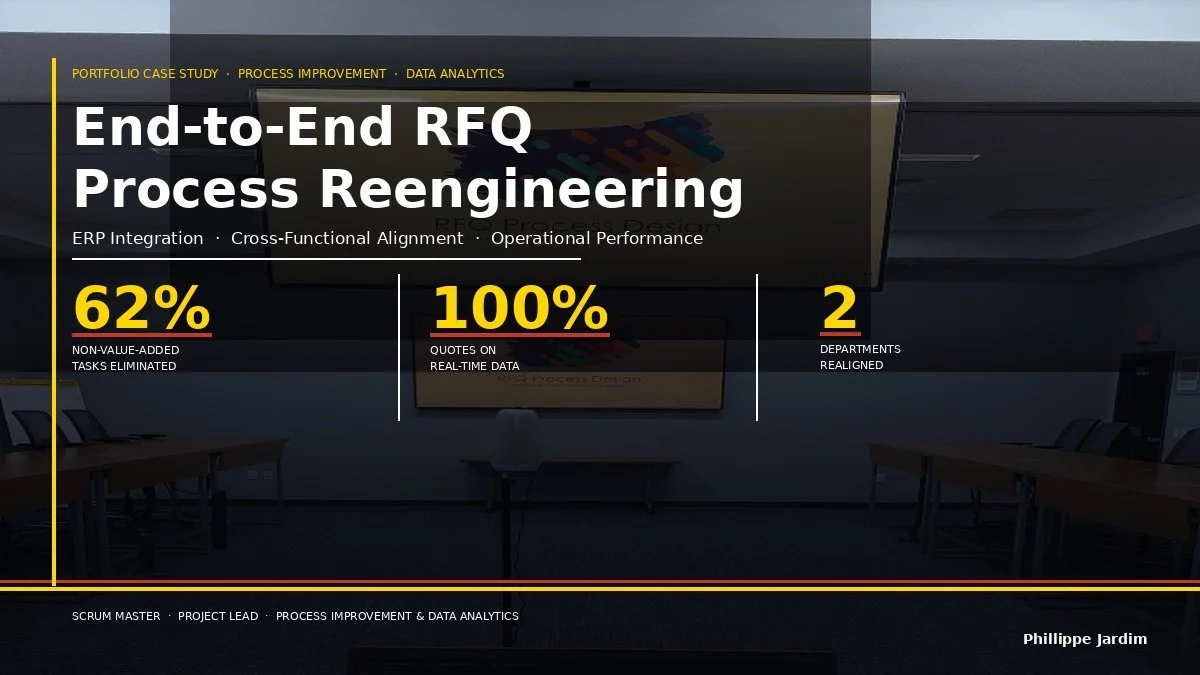
Portfolio case study · Process improvement & data analytics
End-to-End RFQ Process Reengineering: Eliminating System Failures, Integrating ERP Data, and Restoring Operational Performance
How I eliminated 62% of non-value-added tasks, restored cross-functional alignment, and delivered a real-time quoting system in a high-pressure sales environment.
A fast-moving business held back by a fragile tool
Our organization operated in a high-volume sales environment with significant exposure to imported goods and raw materials, a world where price fluctuations are daily realities. The quoting process sat at the center of our revenue engine, and it was running on an Excel macro connected to a database.
The macro was supposed to pull real-time stock availability, item cost, and pricing to generate sales quotes. In practice, it buckled under the volume of user requests and the constant churn of price updates. The business was paying a hidden tax every single day: in delayed quotes, lost margin, and frayed relationships between sales and purchasing.
Business challenge
Five failure modes compounding into one big problem
The dysfunction wasn't a single bug. The fragile macro was just the most visible symptom of deeper misalignment across process, people, and data.
Misaligned or missing data leading to quote errors
Process delays eroding response speed and client trust
Repetitive manual work consuming team capacity
Friction between sales and purchasing over accountability
Lost sales opportunities from late or incorrect quotes
Margin erosion caused by pricing inconsistencies
The stakes were high. Every quote that went out late or wrong was a potential customer lost, a margin left behind, or an email that began with an apology and a discount in the next purchase.
Objectives
What success looked like from day one
1
Eliminate root-cause process failuresDiagnose bottlenecks and standardize operations to ensure accuracy and reliability across the RFQ workflow.
2
Design and deploy a real-time quoting solutionReplace the brittle macro with an ERP-integrated system providing live pricing, cost, and stock data.
3
Restore cross-functional alignmentRebuild trust between sales and purchasing through shared ownership, clear accountability, and a standardized SOP.
4
Free team capacity for strategic workReduce rework and manual effort so both teams could redirect their energy toward higher-value activities.
My role
Project lead for process improvement & data analytics
I took full ownership of this initiative, not as an agile consultant for a quick fix, but as the leader accountable for both diagnosis and delivery. My mandate spanned strategic design, cross-functional facilitation, technology scoping, and change management. I served simultaneously as Scrum Master and project lead, coordinating between departments, guiding the team through ambiguity, and making the key decisions that shaped the outcome.
Approach & key decisions
Understanding before intervening
1
Full-process audit across both departmentsI didn't assume the problem was the tool. I led a structured audit that exposed multiple informal workarounds, an SOP that no longer reflected how work actually happened, and duplicated effort driven by lack of trust in shared data.
2
Cross-functional workshops to build shared ownershipI facilitated structured workshops with sales and purchasing to map the process pain points, surface conflicting assumptions, and co-design the future-state process. Alignment wasn't assumed — it was built deliberately.
3
BPM-driven process mapping from current to future stateUsing business process management software, I led the team through a formal current-state map and redesigned the end-to-end RFQ workflow to eliminate redundancy and create clear handoffs.
4
Requirements definition and vendor selection for ERP integrationRather than rushing to a solution, I defined functional requirements grounded in the process design, then identified and vetted development partners capable of building an ERP-integrated quoting system that matched our operational realities.
Challenges & mitigations
Where the real work was
Process improvement initiatives fail most often not because of technical complexity, but because of resistance, ambiguity, and the pressure to move fast without building a foundation. Here is how I navigated the most significant obstacles.
ChallengeMitigation
Fragmented informal processes made the true current state invisible — each team had its own version of "how things work."
Conducted structured cross-departmental interviews and process observations before drawing any conclusions or proposing changes.
Interdepartmental friction meant that bringing both teams to the same table risked surfacing unproductive conflict rather than shared solutions.
Designed and facilitated conflict resolution sessions focused on shared goals, using neutral process maps as the common ground for productive dialogue.
The existing SOP was outdated and no longer reflected operational reality, making it useless as a reference for change or training.
Rebuilt the SOP from the ground up based on the optimized future-state design, with clear ownership and measurable criteria for each step.
Technology selection risked prioritizing available solutions over operational fit, repeating the conditions that created the original failure.
Anchored vendor evaluation in functional requirements derived from the process design — not features. Requirements drove selection, not the other way around.
Results & impact
A measurable shift in how the business operates
62% reduction in non-value-added tasks freeing significant team capacity that had been trapped in rework, manual lookups, and error correction cycles.
Restored cross-functional alignment — clearly defined ownership and accountability ended the blame cycles between sales and purchasing, replacing friction with a shared performance culture.
Improved customer satisfaction — faster, consistent, and accurate quote delivery translated directly into stronger client relationships and reduced lost-opportunity risk.
Protected and improved profit margins — by standardizing pricing logic and eliminating manual overrides, the business recovered margin that had been silently leaking from quoting inconsistencies.
Lessons learned
The presenting problem is rarely the real problemThe broken macro was a symptom. The root cause was fragmented processes and misaligned teams. Treating the symptom alone would have produced a better macro, not a better business. Diagnosis before intervention is non-negotiable.
People alignment is the critical pathNo system succeeds when the teams using it have no voice in its design. The workshops were where alignment was built, turning two groups with competing priorities into one team committed to a shared goal.
Process design must precede technology selectionSelecting tools before defining requirements is one of the most common — and costly — mistakes in process improvement. Anchoring vendor evaluation in operational requirements protected the project from the trap of buying a solution looking for a problem.
Measurement is what makes improvement realEstablishing baseline metrics before the project began made it possible to quantify impact and demonstrate clear business value. That discipline is what separates credible project delivery from activity without accountability.
"Complex problems don't yield to single fixes — they yield to disciplined thinking, genuine stakeholder partnership, and the commitment to understand before acting. That's the lens I bring to every project I lead."