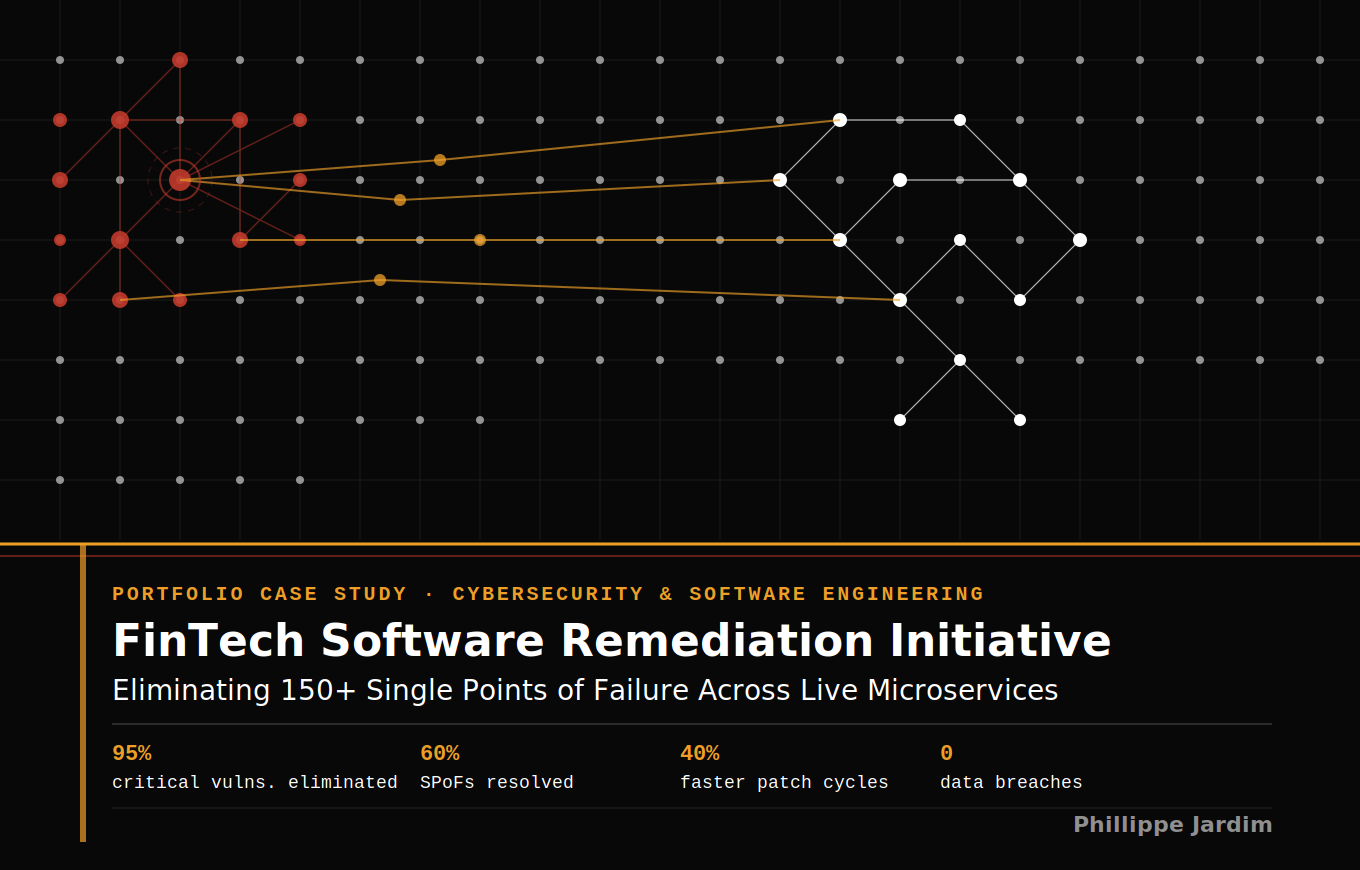
Case Study — FinTech Software Remediation Initiative
Portfolio case study · Cybersecurity & software engineering
FinTech Software Remediation: Eliminating 150+ Single Points of Failure Across a Live Microservices Architecture
How I led a cross-functional remediation initiative that reduced critical vulnerabilities by 95%, eliminated 60% of architectural failure points, and cut patch cycle time by 40% — without a single data breach.
During the COVID-19 pandemic, our FinTech company — like many in the sector — scaled rapidly to meet surging demand for reliable digital trading systems. Speed of growth, however, came at a cost: the software architecture accumulated significant technical debt in the form of outdated Python dependencies, creating exploitable vulnerabilities across systems that handled transaction processing, credit scoring, risk analytics, and customer onboarding.
The architecture consisted of independently developed microservices managed by separate engineering teams. Each team understood their own domain but had limited visibility into how their components interacted with others — creating operational blind spots, downstream risk exposure, and over 150 confirmed single points of failure. Adding to the complexity: all remediation work had to be performed on live systems protecting sensitive Personally Identifiable Information (PII) and proprietary algorithmic models.
Business challenge
Six compounding risks with no margin for error
The cybersecurity infrastructure imposed real challenges. Outdated dependencies had created concrete, classified vulnerabilities across critical financial infrastructure — and the fragmented team structure meant no single group had the full picture of what was at risk.
Outdated Python libraries exposing systems to active external attack vectors
150+ single points of failure across five critical service domains
Engineering teams siloed with no cross-service visibility or shared risk awareness
Live PII and proprietary financial models at risk throughout the remediation window
No standardized patch management process across the organization
Zero tolerance for production downtime or data exposure during the initiative
The compounding effect was significant: each siloed team's patching decision could destabilize services they had no visibility into. The risk was not just technical — it was organizational.
Objectives
What success required from day one
1
Audit and classify all legacy dependenciesIdentify every outdated Python library across all microservices and rank vulnerabilities by business impact using CVSS scoring.
2
Map cross-service interdependenciesBuild a complete dependency interaction map to make downstream risks visible and coordinate remediation sequencing across teams.
3
Execute remediation without production disruptionDeliver all patches through a hybrid agile model with CI/CD vulnerability gates, sandbox testing, and coordinated release management.
4
Protect sensitive data throughout the initiativeMaintain end-to-end encryption, implement RBAC and data masking in test environments.
5
Institutionalize a repeatable processLeave behind standardized patch management workflows and a centralized knowledge base to prevent recurrence at scale.
My role
Project manager for the software remediation initiative
I owned the full project engineering lifecycle — from initial stakeholder identification through final delivery. My role required operating simultaneously as a technical program coordinator, cross-functional facilitator, risk manager, and compliance liaison. I was responsible for aligning five engineering teams — DevSecOps, Data Engineering, Payments, Credit Risk, and Customer Systems — while maintaining continuous production integrity and meeting non-negotiable data protection obligations.
There was no existing standard operating procedure. I led the remediation effort by aligning people, technology, and process — managing stakeholder expectations, coordinating cross-functional teams, and ensuring full compliance with financial system standards and regulations.
Approach & key decisions
A Structured Response to a Fragmented Cybersecurity Architecture
1
Strategic assessment and discoveryI initiated a comprehensive dependency audit using automated scanners combined with internal documentation review. Every outdated library was cataloged and classified by severity. Collaborating with all five engineering domains, I built a prioritized vulnerability register ranked by business impact — not just technical severity — so remediation resources were directed where the cost of failure was highest.
2
Dependency mapping and organizational alignmentThe most consequential early decision was to invest in a full dependency interaction map before a single patch was deployed. This made cross-service risks visible for the first time — allowing teams to understand that their patching decisions had downstream consequences they had previously been unaware of. I facilitated technical alignment workshops across all teams and designated "change captains" in each service domain to own patch risk analysis and testing coordination locally.
3
Hybrid agile execution modelI deployed a deliberate hybrid: Kanban to manage the patching backlog by CVSS priority, Scrum sprints for cross-team QA and release testing, and CI/CD pipelines with automated vulnerability gates that blocked unsafe deployments from reaching production. All patches were validated in sandboxed environments before rollout. JIRA managed workflows; Confluence captured decisions and documentation; daily standups kept cross-team risks surfaced in real time.
4
Data security integration throughout deliveryRemediation and data protection were treated as a single workstream, not sequential phases. I integrated RBAC and data masking into test environments from day one, and verified end-to-end encryption post-patch through regression security testing. Legal and compliance were embedded as active partners — aligned with the Safety by Design initiative from the start.
Challenges & mitigations
Where the real complexity lived
Complexity, in this context, refers to the degree to which a project's interconnected elements — stakeholders, evolving requirements, uncertainties, and dynamic interactions — produce behaviors, outcomes, and constraints that are difficult to understand, predict, and control. The technical remediation was solvable. The harder problems were organizational: aligning teams with competing priorities, building shared situational awareness across silos, and maintaining security integrity while patching live financial systems at speed.
ChallengeMitigation
Teams operated in functional silos with no shared visibility into cross-service risk — a patch in one domain could cascade failures into another undetected.
Built a dependency interaction map before any patching began, then ran alignment workshops to make downstream risks visible to every team simultaneously.
Simultaneous remediation across five domains created coordination complexity that no single team could manage independently.
Appointed change captains in each domain with defined accountability for local risk analysis, testing coordination, and escalation paths.
Patching live systems handling PII and proprietary financial models introduced real-time data exposure risk at every step.
Implemented RBAC, data masking in all test environments, and mandatory regression security testing post-patch — with legal and compliance embedded from the start, not consulted at the end.
No existing patch management standard meant teams defaulted to ad hoc approaches, creating inconsistency and audit risk.
Designed and deployed a standardized patch management framework and centralized knowledge base during delivery, so the organization retained the capability after the project closed.
Inter-team conflicts over resource priorities threatened to delay critical path items during high-severity patch windows.
Mediated resource decisions using objective CVSS-based prioritization, removing subjective team preferences from sequencing decisions and establishing a shared escalation protocol.
Results & impact
Security posture transformed across every severity tier
Vulnerability reduction
95% reduction in critical vulnerabilities — the highest-risk attack surface eliminated across all five service domains.
67% reduction in high-severity threats, 20% in medium-severity, and 42% in low-priority issues — a systemic improvement across all risk tiers.
Architectural resilience
60% of single points of failure eliminated — reducing cascading failure risk across transaction processing, credit scoring, and customer systems.
Centralized vulnerability knowledge base established — giving the organization a durable capability for tracking and managing future exposure.
Operational and compliance outcomes
40% reduction in patch cycle time — the standardized delivery model compressed execution speed and became the organizational baseline going forward.
Zero data breaches or PII exposures during the entire remediation window — across live financial systems processing sensitive transactions.
Lessons learned
What this project reinforced about how I work
Visibility is the prerequisite for coordinationNo amount of planning compensates for teams operating without shared situational awareness. The dependency interaction map was the single most impactful early investment — it converted a fragmented five-team operation into a coordinated remediation program. In complex system environments, making risk visible is itself a form of risk management.
Security and delivery must be integrated, not sequentialEmbedding compliance and data protection into the delivery model from day one — rather than treating them as a post-project audit — eliminated a class of risk that typically surfaces at the worst possible moment. When legal, compliance, and engineering share the same delivery cadence, the organization moves faster and safer simultaneously.
Objective criteria resolve subjective conflictsInter-team resource conflicts are inevitable in multi-domain programs. Anchoring prioritization decisions to CVSS scores rather than team preferences removed the political dimension from sequencing decisions. Shared criteria create shared accountability — and they hold under pressure in ways that negotiated agreements do not.
The deliverable must outlast the projectA remediation that closes vulnerabilities without leaving behind a standardized process simply defers the same problem. Building the knowledge base and patch management framework during delivery — not after — ensured the organization retained operational capability. A project that doesn't change how the organization works has only solved today's problem.
"In high-stakes environments, the project manager's job is not to manage tasks — it is to engineer the mechanisms that simplify complexity and surface clarity. When every team can see the full system, every decision improves. That is the standard I bring to every engagement."